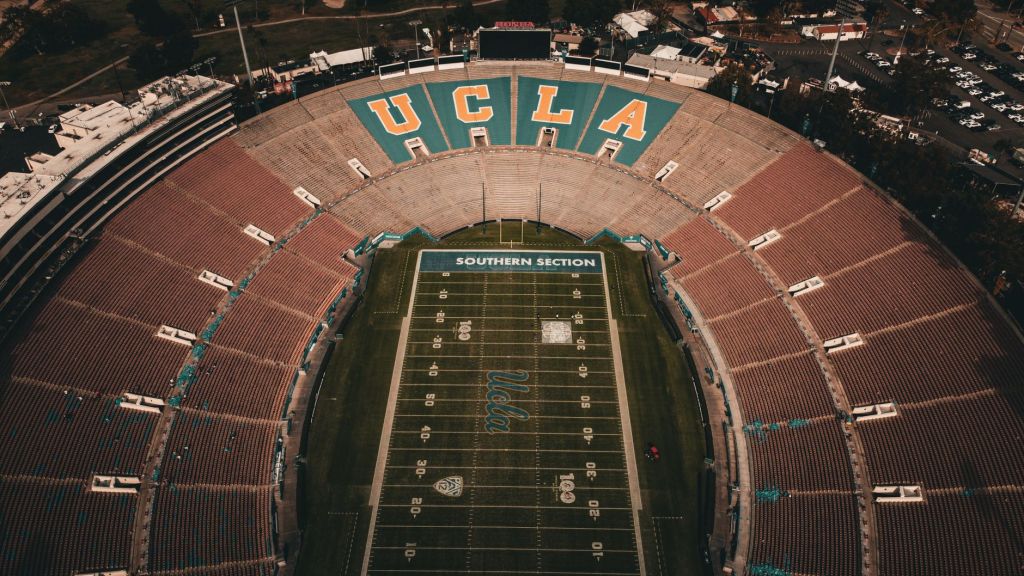
While university football in the United Kingdom often operates on the periphery of the professional game, the American collegiate system presents a markedly different model, one in which higher education and elite sport are deeply interconnected. For players like Daniel, choosing to pursue a scholarship in the United States was not simply an alternative to the traditional English pathway, but a strategic decision shaped by both immediate opportunity and long-term security.
“I chose the American route because it gave me the platform to train and compete every day at a high level, while also allowing me to pursue a degree in finance fully sponsored by my football team,” he explains. “Once I really weighed my options and thought about my long-term career and life after football, this made the most sense.”

Daniel’s experience reflects a system designed to integrate athletic development with academic progression, rather than forcing players to navigate the two independently. His weekly schedule illustrates the intensity and structure of this environment. Days begin as early as 7 am, with training sessions and gym work running through midday, followed by recovery protocols that include ice baths, rehabilitation, and physiotherapy. Academic commitments occupy the latter part of the day, with multiple classes extending into the early evening before study and recovery resume at home.
This routine is for student-athletes. During the fall semester, fixtures often involve extensive travel, with players regularly flying across the country for matches. In some instances, Daniel describes returning in the early hours of the morning, only to attend classes later that same day. The demands placed on athletes within this system are therefore not reduced in comparison to professional environments but instead replicated within an educational framework.
What distinguishes the American model, however, is not solely the intensity of its training schedules but the level of institutional support that underpins them. As a fully funded scholarship athlete, Daniel’s tuition, accommodation, meals, equipment, and academic resources are all covered. This comprehensive provision removes many of the financial and logistical barriers which often go with dual career pathways, allowing players to focus on both their sporting and academic development without compromise.
Crucially, this system is also aligned with a recognised pathway into the professional game. “Every year, around 100 college players are drafted into the MLS,” Daniel notes, reinforcing the visibility and legitimacy of the collegiate route. Unlike the UK model, where university football exists largely outside of the professional recruitment structures, the American system is directly connected to them. For players within this environment, progression is not an abstract possibility but a defined outcome embedded within the structure itself.
Yet, despite this clear pathway, Daniel’s reflections also highlight an awareness of the broader realities of a football career. While he keeps a strong belief in his ability to reach the professional level, he equally recognises the importance of preparation beyond the game. “Football is a short career, and having a backup plan is essential,” he explains. “Knowing I have a solid degree and a strong CV gives me security.”
This dual perspective is central to understanding the effectiveness of the American model. Rather than positioning education as a secondary consideration, it is integrated as a parallel priority, ensuring players are not forced to choose between ambition and stability. In contrast to the UK system, where university football often functions as a form of recalibration following academy release, the American pathway allows both trajectories to develop simultaneously.

Daniel’s experience, therefore, challenges the notion of scholarships as either a “second chance” or a “safety net.” Within the US system, they operate as both a platform for professional progression and a mechanism for long-term security. With this balance, it distinguishes the collegiate model and, in doing so, raises important questions about the structural limitations of university football within the United Kingdom.
The UK Scholarship Reality: Inside the System
While institutional narratives often present football scholarships as a structured pathway within higher education, the lived experiences of players embedded within these programmes suggest a far more complex reality. Speaking to final-year scholarship athletes competing in the British Universities and Colleges Sport (BUCS) system at the University of East London, a clearer picture begins to emerge, and you start to understand the extent to which university football functions as a viable route to the professional game.
For many of these players, the notion of university football as a stepping stone into professional football is met with a degree of scepticism. One scholarship athlete states bluntly that there is “100% no avenue into the professional game,” describing the system instead as “a chance to prolong the inevitable,” referring to the eventual transition away from football as a primary ambition. This perspective reflects a stark contrast to the structured progression outlined within the American collegiate model, where professional opportunities are embedded within the system itself.
Rather than operating as a direct pathway, university football in the UK appears to exist alongside more established routes, rather than feeding into them. As another explains, “to make any real moves into the professional game you must play for a team outside of university at a semi-pro level to get noticed.” This highlights a key structural limitation: while universities provide competitive fixtures and training environments, they do not command the same level of attention from scouts and professional networks as non-league football or academy systems. Even then, the player acknowledges the reality that “the chances of being scouted at the age of 20-21 are very unlikely,” reinforcing the idea that by this stage, many decisions within professional football have already been made.
These insights point towards a system that, while beneficial in many respects, operates without a clearly defined progression route into the upper tiers of the game. Competitions organised under BUCS offer regular fixtures and a national structure, yet their visibility remains limited within the wider football landscape. Unlike the American model, where university sport is integrated into professional recruitment programmes, UK university football continues to function on the margins, with progression reliant on external exposure rather than internal mechanisms.
However, to frame the scholarship experience solely in terms of missed professional opportunities would present an incomplete picture. Alongside these critical perspectives, players also emphasise the value of the environment itself. One respondent reflects on the experience as something they will “carry for the rest of their lives,” highlighting the importance of team culture, shared experiences, and the sense of belonging created within the university setting. The “family dynamic” described within the squad suggests that, beyond career outcomes, scholarships provide a meaningful and supportive space for personal development.
This duality sits at the heart of the UK scholarship system. On one hand, it offers structure, high-level competition, and a continuation of the footballing journey at a critical stage in a player’s life. On the other hand, it does so without the same level of professional visibility or progression opportunities found elsewhere. As a result, players are often required to navigate multiple pathways simultaneously, aiming to balance university commitments with participation in semi-professional football to remain visible within the game.
In this sense, university football in the UK functions less as a direct pathway and more as a parallel environment, one that supports development but does not necessarily facilitate progression. For many players, it becomes a space where ambitions are gradually redefined rather than realised, where the pursuit of professional football continues, but with an increasing awareness of its limitations.
These findings reinforce the broader argument of this investigation. While football scholarships in UK universities provide valuable opportunities for education, personal growth and continued participation in the sport, their role as a genuine pathway into the professional game remains limited. Instead, they operate more effectively as a form of structured transition, something you can turn to that allows players to expand their engagement with football whilst laying foundations for what life beyond university will be like.
Stay tuned for next week as I speak on the experiences of those directly involved in scholarship programmes and what they reveal about the current system.


Leave a comment