

The harsh introduction to life for Taribo West didn’t allow time for him to dream of packed-out stadiums filled with fans. It was instead replaced by the reality of living in a hostile environment. He and his mother were forced out, left to survive with little to nothing, causing more uncertainty about what life has planned for him.
In a country where opportunities are often dependent on chance, Taribo quickly learnt that survival was not optional. Football became his lifeline.
The community he was surrounded by would’ve consumed him; no future would’ve amounted to success if he hadn’t clinched onto the hope of playing high-level football. He played wherever he could, holding onto the belief that football would elevate him beyond his surroundings. What stood out was the urgency matched with the talent, the understanding that there was nothing to fall back on if he hadn’t made it.
This urgency caught the eyes of coach Monday Sinclair, a man who would change the life of the young, tenacious Nigerian. Coach Sinclair became a father figure, something that was missing from Taribos’ life for years. He saw the fighter in him, which led to him being moulded and being protected, which Taribo needed to maximise his potential on the pitch.
When Taribo eventually made it to Europe, his nature was soon displayed on the pitch, pure aggressiveness. Each tackle he made felt personal. Each 50/50 felt like he was still fighting for his future. It was never a pretty sight watching him duel his opponents, but it was a way of unleashing his true self in the only way that made sense. A warrior who defended as if losing was never an option.
The long-braided hair, dyed in the colours of the clubs he’d represented, was symbolic. The neon green, noticeable from all angles, is etched into football culture as a way of expression. He was impossible to ignore. Having played alongside historic football players, such as R9, Jay-Jay Okocha, and Zanetti, his name was not spoken on enough, considering the achievements he had during his career.
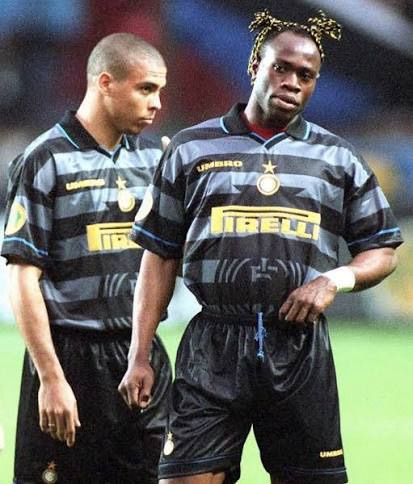
Thierry Henry admitted that Taribo West was one of the most unforgettable defenders he faced in Ligue 1. Not for glamorous stats or silky play, but for his presence, fearlessness, and fight he had in each game he played. These attributes not only helped the team defensively but also gave teammates a sense of confidence. It’s almost a form of leadership, battling for your team and being the first to put your body on the line is what Taribo West thrived in.
Never witnessing the golden generation of the Nigerian national team is something I would have loved. Being born in 2003, those iconic nights, the battling performances, the aura of players like Taribo West could only be viewed via low-quality clips online, stories from older fans, and highlights played long after those moments had gone.
Learning about what those players represented goes far beyond the titles and results on the pitch. They carried the responsibility of representing the nation with pride. Knowing the history they helped create makes supporting Nigeria feel deeper than football. A nation rooted in struggle and resilience.
Taribo West epitomised what authenticity is in football; he didn’t care for being liked by people, but rather demanded respect, which he rightfully earned with his imposing play style that any attacker would stay up at night thinking about. Understanding his journey to professional football wasn’t needed as long as you witnessed him set foot on the pitch.
After football, life took a path a few would have predicted for him. After the spotlight moved on, it led him down a path of faith, away from the public eye. Today, Taribo West is a pastor, dedicating his life to service rather than the sport he once thrived in. To some, this would be seen as a fall from grace. For Taribo, it’s his rebirth.
Taribo West has spoken openly about the moment his life shifted from football, saying, “Why would I switch from being a footballer to becoming a pastor? I saw God one-on-one. That’s where my transition started.” This statement shows that football was just a step towards what he deems to be his end goal. His story challenges the idea that success is measured by trophies, reminding us that the legacy can be defined by evolving beyond the game.

It’s a story that shouldn’t be buried in the history books. Not because of his green hair, matchups with legends on the pitch, but what his journey means to prospects in the game growing up in difficult circumstances. He’s living proof that your football dreams shouldn’t be diminished by your home life. If anything, these struggles should be used to fuel your motivation and hunger to succeed. He wasn’t polished. He wasn’t protected. He was real. And it’s exactly why his story matters.




 Beyond the Pitch
Leave a comment